
Spatial segmentation of impulse response for room reflection analysis and auralization
Posted on 12 Mar 2025 by APL
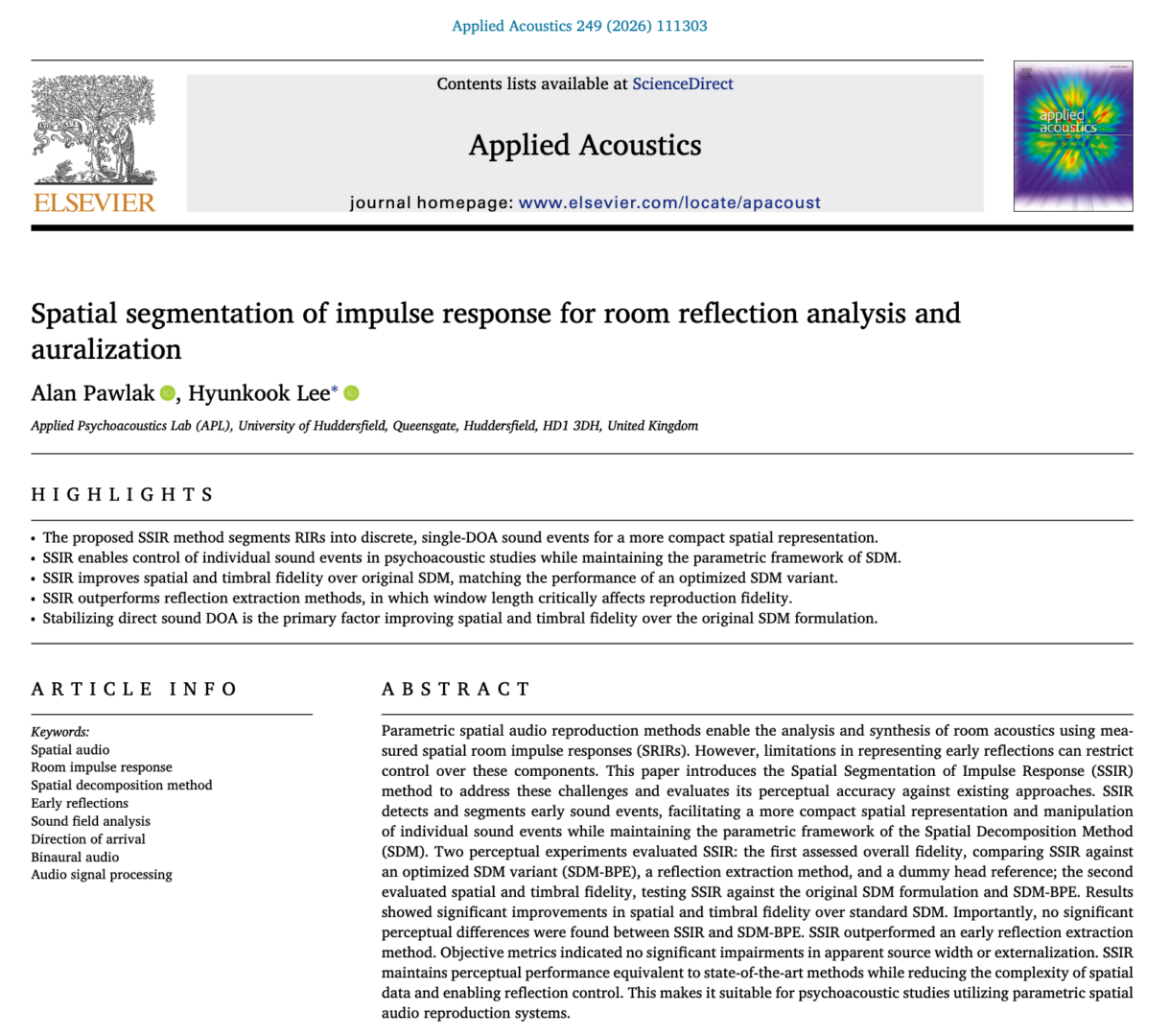
Our new study introduces a more efficient way to analyse and auralise room reflections in spatial audio!
We published a new paper in Applied Acoustics presenting a method that could improve how room acoustics are analysed, represented and reproduced in spatial audio systems. The study, titled “Spatial segmentation of impulse response for room reflection analysis and auralization,” was authored by Dr Alan Pawlak and Prof Hyunkook Lee. It was Alan’s PhD project supervised by Prof Lee and funded by Genelec Oy.
The paper introduces a new technique called Spatial Segmentation of Impulse Response (SSIR). It was developed to address a longstanding challenge in parametric spatial audio reproduction: representing early reflections in a way that is both perceptually accurate and more manageable for analysis and creative control. Early reflections play a major role in how listeners perceive space, source width, timbre and realism, yet existing methods can make them difficult to isolate and manipulate effectively.
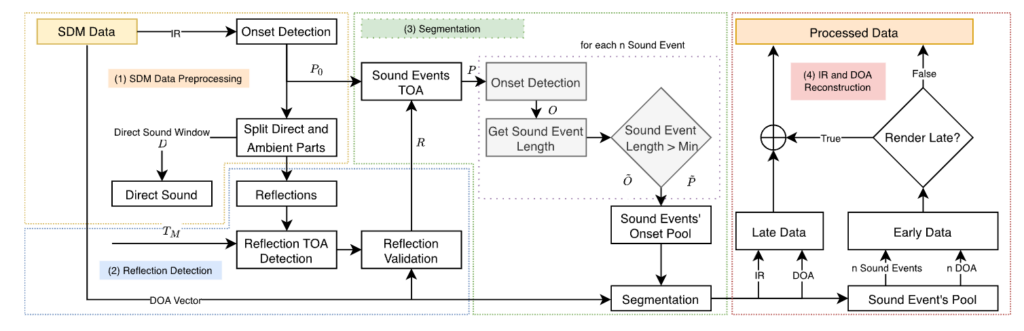
SSIR works by detecting and segmenting early sound events within measured spatial room impulse responses (SRIRs), allowing individual events to be represented more compactly while remaining within the framework of the well-established Spatial Decomposition Method (SDM). According to the paper, this enables more efficient spatial representation and greater control of individual reflections without sacrificing perceptual performance.
To evaluate the method, the researchers carried out two perceptual experiments. The first tested overall fidelity by comparing SSIR with an optimized SDM variant, a reflection extraction method and a dummy head reference. The second focused on spatial and timbral fidelity, comparing SSIR against both the original SDM formulation and the optimized SDM variant. The results showed that SSIR delivered significant improvements in spatial and timbral fidelity over standard SDM, while showing no significant perceptual difference from the state-of-the-art optimized variant. It also outperformed an early reflection extraction approach.

Importantly, the study reports that SSIR achieved this while reducing the complexity of spatial data and preserving key perceptual qualities such as apparent source width and externalisation. This makes the method promising not only for room acoustic analysis and auralisation, but also for psychoacoustic research and future spatial audio tools where efficient yet perceptually robust room representation is needed.