
Why Room Simulation and Head Tracking Matter in Binaural Audio
Posted on 26 Mar 2025 by APL

Creating a truly realistic binaural listening experience takes more than just good HRTFs. To make headphone reproduction sound natural, convincing, and speaker-like, two other elements are just as important: room acoustics and head tracking.
Without them, even binaural rendering with accurate directional cues can still sound unnatural or unstable.
HRTFs Alone Are Not Enough
Head-related transfer functions (HRTFs) are essential for binaural reproduction because they provide the directional cues our ears use to localise sound. But HRTFs on their own do not guarantee realistic externalisation.
When binaural audio is based only on anechoic HRTFs, sounds tend to become internalised – perceived inside the head rather than out in space. This is like listening in an anechoic chamber, where there are no natural room cues and distance perception becomes limited, relying heavily on loudness alone.
Furthermore, when listening to anechoic or very dry binaural audio in a lively room, the brain has to reconcile the visual and acoustic cues of the physical space with the unnaturally dry sound presented over headphones. This mismatch can make externalisation more difficult and increase cognitive load.
That is why room acoustic simulation is so important.
Room Acoustics Help Sound Leave the Head
A realistic sense of externalisation depends heavily on the acoustic context around the sound source. Reflections and reverberation help the brain interpret where a sound is located and how far away it is.
APL VIRTUOSO’s perceptually optimised, natural room simulation helps provide this missing context, making binaural listening feel far more like listening to real loudspeakers in a real space. It supports stronger externalisation and a more believable sense of space, while preserving the tonal integrity of the original source, much like listening in a very well-treated studio through premium monitor speakers. VIRTUOSO’s high-quality binaural rendering has been validated in academic research and endorsed by many world-class sound engineers.
But even with a perfect room simulation, something important is still missing if the listener’s head remains perfectly still.

Real Hearing Is Dynamic, Not Static
In everyday listening, we rarely hear the world with our head completely fixed. Even very small head movements continuously update the binaural cues reaching our ears, including interaural time and level differences, and spectral changes.
These dynamic changes are a fundamental part of how we localise sound and judge auditory distance.
With static binaural listening, those updates are absent. As a result, some sounds, especially those positioned directly in front, such as a phantom centre or real centre channel, may still not feel immediately externalised, even when the room simulation is good.
Head Tracking Makes Binaural Audio Feel Real and Natural
Head tracking restores the natural dynamic behaviour of hearing. As the listener moves, the virtual sound field updates accordingly, just as it would with real loudspeakers. This makes externalisation stronger, localisation more accurate, and the entire listening experience more natural and convincing. When dynamic cues are missing, listeners may need to work harder cognitively to interpret the virtual sound scene. Head tracking helps relieve that effort by giving the auditory system the information it naturally expects.
Head tracking is especially important in headphone mixing because it stabilises the virtual sound stage and makes spatial positions feel more natural and speaker-like. In immersive work, this helps engineers judge localisation, depth, width, and front-back placement more accurately, leading to more reliable mix decisions and better translation to loudspeaker playback.
A Solution to Front/Back Confusion
One of the most persistent problems in binaural reproduction is front/back confusion – when a sound in front is misperceived as coming from behind, or vice versa. Head tracking plays a crucial role in reducing this problem.
A slight turn of the head causes opposite cue changes for front and rear sources, giving the brain the information it needs to distinguish between them. Research has shown that even with personalised HRTFs, front/back confusions can remain significant when head movement is restricted. Allowing even small head rotations can substantially reduce these errors and improve spatial realism.
APL VIRTUOSO + HeadTrek
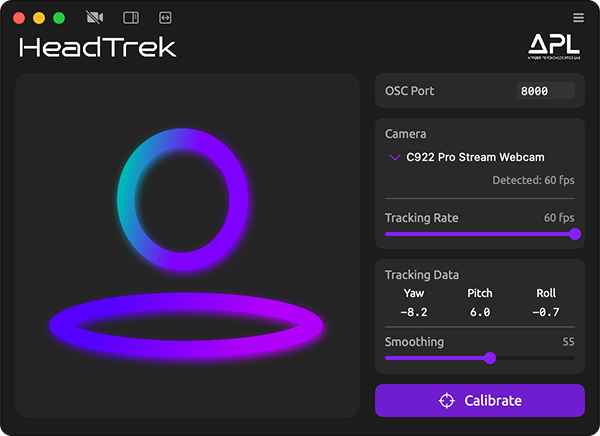
APL HeadTrek is a lightweight, camera-based head tracking solution designed to work seamlessly with APL VIRTUOSO on macOS.
Free for both existing and new VIRTUOSO users, it uses standard webcams or built-in cameras to track head orientation in real time and transmit that data directly to VIRTUOSO. This enables more accurate binaural monitoring and a more immersive listening experience, without the need for specialised hardware.
The result is a practical and accessible way to bring binaural reproduction closer to the realism of real loudspeaker listening.
The Bottom Line
Realistic binaural audio is not just about reproducing the right directional cues. It is about recreating the way we naturally hear sound in space.
HRTFs provide the directional foundation, but on their own they are not enough. Room simulation provides the acoustic context that helps sounds externalise naturally, convey distance, and preserve a believable sense of space. Head tracking then brings the experience fully to life by restoring the dynamic cue changes that occur as we move our head in everyday listening.
Together, these elements make binaural listening more natural, immersive, and much closer to the experience of hearing real loudspeakers in a real room.